Summary
Review
Takeaway
2026.8.4
"Oscar Wilde," by Sheridan Morley
Summary: Biography of Oscar Wilde.
Review: It's pretty dry and English. Doesn't include any of his work or witticisms, so major bummer. Oscar Wilde was an Oxford eccentric and the original flower boy aka "aesthete" as in "effete" and actually made his name as a funny lecturer in America. There was lots of gay sex with 18yo boys to be had. Eugh. Anyways, he barely makes it until he writes The Picture of Dorian Gray which was borderline obscene, as so much of "groundbreaking" fiction is... Then he writes some great plays about Victorian England mostly out of his conversational witticisms, goes to jail for boinking a Scottish lord's son and then in a fit of depression refuses to leave the country, he gets out after two years and moves to France, goes on yet another spree in the Mediterranean, has yet more drama with his young boy lovers, is broke, dies. Post mortem, England realizes, "Damn, he was a pretty good writer." I swear, I hate reading biographies of great writers. Why do I keep doing this?
Takeaway: Yeah he was like a pedo and a flamboyant gay. Incredibly charming, good writer, blew his money, totally immoral. Also an aristocratic snob who got arrogant later on, one of the "beautiful people," as he coined it. Now I'm depressed.
"Morvern Callar," by Alan Warner
Summary: It's like if Charles Dickens applied Social Realism to broke-as-fuck Scottish ravers.
Review: Sex, drugs, depression, realism (more depressing). Way less artsy than the movie, lots of being rampant and getting mortal as newts. Also, the movie has lots of silence, the book is filled with music and mixtapes.Book and movie are totally different. Still good... I prefer the movie's quietness. The movie does miss out on basically the entire plot and focuses on visualizing silence, thought, emotions? Morvern talks very little in the movie and in the book, but there's more action in the book for her to muddle her way through, fucking and dodging and weaving through blowing all of her money. If I hadn't seen the movie, I don't think I would've read or finished the book, it epitomizes the "adult fuction" I hate. There are some nice quiet moments for introspection. Also she does the same thing I do, using You and I interchangeably.
Takeaway: Uhhh people suck. Your best friend may fuck your boyfriend and also your dad, and she's a bitch. But you're all drunk mortal as newts and getting rampant by the minute, that's Scotland I guess. Don't be like this, man. Save the money and do something reasonable... instead of paying 3000 to stay in a hotel with fratboys. Literally the bottom of the heirarchy, if you ask me. OH, there is some interesting play between the heat of vacation and the cold of Scotland. Funny that after she gets tanned and perfect, she chips her nail and is losing her shit. Which is more noble, wageslaving and partying in Scotland or blowing it in Spain? Both suck.
2026.3.11
"William Shakespeare: The Comedies"
Summary: Collection of comedic plays by Shakespeare.
Review: They're pretty fun to read. They're a bit long and repetitive though, I bet they're better to see in person. There are so many turns of phrase, and some of them are pure... poetry? Really good. But there's so many passages... a lot of them are bums, but occasionally they are perfect. I should also mention the volume: Shakespeare was a very prolific writer, so it follows that quantity is not always quality.
Takeaway: It seems like Christian entertainment. The good guy ends up winning through some strange fortuitous/clever turn and forgives the bad guy, who somehow just peacefully accepts this? It's surreal. "The Merchant of Venice" is actually about a rich debt shark Jew who's trying to kill a Christian rich guy who would pay up so that the Jew couldn't screw over other people, except the Christian loaned all his money to his buddy to go woo a rich lady and took out a loan with the Jew. Evidently, not government friendly.
"Madame Bovary," by Gustave Flaubert
Summary: A quixotic French woman goes in search of pure romantic love above her circumstances and flouts every thing in her way.
Review: It's a realist tragedy, but subtly romantic, in the search of romance. It's captivating and symbolic while also being domestic and mundane. She's deplorable, but also "literally me." Romantics don't do well in reality.
Takeaway: I can see why they call Flaubert the father of modern writing, the classic style of completely understanding the character in a way that they don't even understand themselves is obvious to me now... after an essay on it. This book actually makes me want to write about romanticism vs. realism in fiction, which will come soon. "The cure for romanticism," basically, but the author had an ironic love/hate relationship with romanticism.
Quotes: "She walked out. The walls were quaking, the ceiling was threatening to crush her; and she went back down the long avenue of trees, stumbling against piles of dead leaves that were scattering in the wind. At last she reached the ditch before the gate: she broke her nails on the latch, so frantically did she open it. Then, a hundred yards further on, out of breath, ready to drop, she paused. She turned: and once again she saw the impassive chateau, with its park, its gardens, its three courtyards, its many-windowed facade.
She stood there in a daze. Only the pulsing of her veins told her that she was alive: she thought she heard it outside herself, like some deafening music filling the countryside. The earth beneath her feet was as yielding as water, and the furrows seemed to her like immense, dark, breaking waves. All the memories and thoughts in her mind poured out at once, like a thousand fireworks. She saw her father, Lheureux's office, their room in Rouen, another landscape. Madness began to take hold of her; she was frightened, but managed to control herself -- without, however, emerging from her confusion, for the cause of her horrible state -- the question of money -- had faded from her mind. It was only her love that was making her suffer, and she felt her soul leave her at the thought -- just as a wounded man, as he lies dying, feels his life flowing out with his blood through the gaping hole."
"She slowly passed her hand through his hair. The sweetness of her touch was more than his grief could bear. He felt his entire being give way to despair at the thought of having to lose her just when she was showing him more love than ever in the past; and he could think of nothing to do -- he knew nothing, dared nothing: the need for immediate action took away the last of his presence of mind.
Emma was thinking that now she was through with all the betrayals, the infamies, the countless fierce desires that had racked her. She hated no one, now; a twilight confusion was falling over her thoughts, and of all the world's sounds she heard only the intermittent lament of this poor man beside her, gentle and indistinct, like the last echo of an ever-fainter symphony."
2026.2.27
"Cosmopolis," by Don Delillo
Summary: The uber-rich, uber-savvy owner of a prominent investment firm goes on a crazy bet against the yen and we watch his disintegration over a single day, as he follows his quest to get a haircut.
Review: There's a LOT here. The writing is so tight and fast-paced that you can't miss a sentence. It's crammed with goodies and fine writing and interesting characters and the usual political themes, but whirlwind fast. It's about 200 pages. The dialogue finale is really amazing.
Takeaway: The book is about tech, reading the future, and wealth. The businessman is portrayed as a prophet of information, but his tragic mistake is that conclusions made from data can be trusted and relied on, when in fact life is made of miserable chance and unpredictability. Furthermore, as a businessman, (and murder is the logical extension of business) his instinct to destroy and live vicariously on the deaths of other moguls and carnally through sex -- his bestiality that makes him the apex predator, becomes self-destructive. The only free choice, uncontrollable and unprofitable by the market or the system, where absolutely noone wins, is self-destruction.
I think he's unsettled, because the rules he operates by are illogical and failing. He's done everything, he's on top of the world, but stupid dumb chance and life will overpower him. He's unbalanced.
"Violence needs a purpose." "You should have listened to your [asymmetrical] prostate... you should have been tracking the yen in its tics and quirks. The little quirk. The misshape." "When he died he would not end. The world would end."
"The Beautiful and the Damned," by F. Scott Fitzgerald
Summary: It's an ugly realist tragedy about a young, pretty, nihilistic couple. She's the prettiest, smartest girl, and he's expecting money from his parents.
Review: A really scathing book, pretty and unbearably dull at times. If Fitzgerald wasn't so good at writing, he'd be a bit of a boring preacher, except I have the feeling that he does actually respect the cynical viewpoint and the intelligence behind it, but he himself can't approve of it. Like me, he hates his generation. Patch is pathetic and quixotic, and the pair of them are really... horrible. It's ironic that they're externally vain and obsessed with cleanliness while internally they're degenerates. It's a really sad, human, normal kind of life. Honestly, don't read this book for fun, because it tastes like medicine.
Takeaway: Cynicism, and quixotic idealism and perfection is the result of impassioned youth, but that kind of idealism fades away into pragmatism, and if it doesn't, it gets crushed by reality. As much as they like to pretend nothing matters, they're the most inherently materialistic bastards obsessed with his grandfather dying so they can get his money, and she's obsessed with her beauty, because she only exists to be beautiful and looked at. I'm so sympathetic it's painful. Maybe this means something about me.
Quotes and Passages
"There was no rest, no quiet. He had been futile in longing to drift and dream; no one drifted except to maelstroms, no one dreamed, without his dreams becoming fantastic nightmares of indecision and regret."
"Dear little Dot, life is so damned hard... it just hurts people and hurts people, until finally it hurts them so that they can't be hurt ever any more. That's the last and worst thing it does... You'll forget. Things are sweeter when they're lost. I know -- because once I wanted something and got it. It was the only thing I ever wanted badly, Dot. And when I got it it turned to dust in my hands."
"He told her this among many other things, very correctly and with a ponderous manliness that masked a real suffering. Loving him not at all she grew sorry for him and kissed him sentimentally one night because he was so charming, a relic of a vanishing generation which lived a priggish and graceful illusion and was being replaced by less gallant fools. Afterward she was glad she had kissed him, for next day when his plane fell fifteen hundred feet at Minesola a piece of a gasolene engine smashed through his heart."
"Looking though the frail curtains she could see the rounded moon over the roofs and beyond it on the sky the yellow glow from Times Square-- and watching the two incongruous lights, her mind worked over an emotion, or rather and interwoven complex of emotions, that had occupied it through the day, and the day before that and back to the last time when she could remember having thought clearly and consecutively about anything--which must have been while Anthony was in the army.
She would be 29 in February. The month assumed an ominous and inescapable significance--making her wonder, through these nebulous half-fevered hours whether after all she had not wasted her faintly tired beauty, whether there was such a thing as use for any quality bounded by a harsh and inevitable mortality.
Years before, when she was twenty-one, she had written in her diary: "Beauty is only to be admired, only to be loved--to be harvested carefully and then flung at a chosen lover like a gift of roses. It seems to me, so far as I can judge clearly at all, that my beauty should be used like that..."
And now, all this November day, all this desolate day, under a sky dirty and white, Gloria had been thinking that perhaps she had been wrong. To preserve the integrity of her first gift she had looked no more for love. When the first flame and ecstasy had grown dim, sunk down, departed, she had begun preserving--what? It puzzled her that she no longer knew just what she was preserving--a sentimental memory or some profound and fundamental concept of honor. She was doubting now whether there had been any moral issue involved in her way of life--to walk unworried and unregretful along the gayest of all possible lanes and to keep her pride by being always herself and doing what it seemed beautiful that she should do. From the first little boy in an Eton collar whose "girl" she had been, down to the latest casual man whose eyes had grown alert and appreciative as they rested upon her, there was needed only that matchless candor she could throw into a look or clothe with an inconsequent clause--for she had talked always in broken clauses--to weave about her immeasurable illusions, immeasurable distances, immeasurable light. To create souls in men, to create finie happiness and fine despair she must remain deeply proud--proud to be inviolate, proud also to be meltinig, to be passionate and possessed.
She knew that in her breast she had never wanted children. The reality, the earthiness, the intolerable sentiment of child-bearing, the menace to her beauty--had appalled her. She wanted to exist only as a conscious flower, prolonging and preserving itself. Her sentimentality could cling fiercely to her own illusions, but her ironic soul whispered that motherhood was also the privilege of the female baboon. So her dreams were of ghostly children only--the early, the perfect symbols of her early and perfect love for Anthony.
In the end then, her beauty was all that never failed her. She had never seen beauty like her own. What it meant ethically or aesthetically faded before the gorgeous concreteness of her pink-and-white feet, the clean perfectness of her body, and the baby mouth that was like the material symbol of a kiss.
She would be twenty-nine in February."
2026.2.25
"Fall to Pieces," Mary Forsberg Weiland
Summary: Biography of a model who marries a rock star, they both have domestic/mental problems and get into heroin. Eventually she breaks out of addiction and he does too, through help from rehabbed Guns 'n Roses members.
Review: Personal, fun to read. 3/5
Takeaway: It takes YEARS of effort to recover from an addiction and all the problems that cause it, and endless relapses. Drugs are fun, but life is better.
"The Orthodox Way," Bishop Kallistos Ware
Summary: Down to earth explanation of the Way, or Christianity, with some digressions for Orthodox Christianity. Uses lots of quotations from previous religious writers.
Review: 4/5. Didn't convert me, but as good as a religious book can be. The writing is not confrontational and good to read.
Takeaway: Explained the trinity for once: The Father is the non-entified god, the Son is the human incarnation and truly 100% human, and the Spirit is the material world and the energies of God. Very roughly, because Christianity actually has a hard time delineating them, and explaining God is always a bad idea.
"Adobe Houses for Today," Laura and Alex Sanchez
Useful for adaptable houseplans and some history on adobe. Skimmed it, solo quiero aprender puedo hecho adobe. (fuck my spanish)
"Surviving Heroin: Interviews with Women in Methadone Clinics" Friedman and Alicea
Summary: What it says on the tin.
Review: Didn't finish. Very dry, lot of feminist apologetics and explanation on the behalf of the victims that's unnecessary and annoying. I just want to hear their story, not the author's intervention.
Takeaway: Methadone helps, but the bureaucracy can suck. Also, anyone can be addicted, rich, poor, queer, black, or white. People need this shit to function and avoid relapse.
"Demonology: Sorting Fact from Fiction," Riley Star
Summary: A little essay and a list of some demons.
Review: Not impressive. Also the clickbait picture of the author is fucking hilarious.
Takeaway: Pre-zoroastrian culture mashup, the Jews used to believe that Satan was actually an angel working for God as the Tempter, which makes a lot more sense theologically. I think Judaism would have been a lot more balanced if it stayed that way. Also, they considered Phoenixes a demon.
"Cicero," Anthony Everitt
Summary: Life of Cicero, a Roman politician before and after the time of Julius Caesar. He was very politically involved and one of the last Old Guard who managed to survive and then attempt to protect the Republic from the Caesarian monarchy and from the national problems tearing Rome apart.
Review: It's okay, writing wise. There's a lot to cover, and Everitt does a good job moving along. I expected to hear more about his career as a writer and master of rhetoric, being one of the last, but it was primarily about politics.
Takeaway: People should learn more about the fall of Rome, it's pertinent to the U.S.. Rome and the U.S. are both empires based on conquest that became unsustainable governments and led to violence and partisan politics.
Basically, the government was unsustainable, and Cicero, who was raised within the senate, saw the need for change but believed that the republic and constitution was indestructible. Caesar didn't care for the politics or establishment and realized that the age of politics and debate was over, and Rome was going to be ruled by military might. Cicero's last days were spent trying to prevent a military takeover by any means possible, which was drastically different from his earlier, idealistic outlook. He changed from trying to improve the republic to trying to save it and from an idealist to a moderate. Ironically, his greatest contribution to modern society was the books he wrote on morality and government, not the politics he spent his life on. The things he spent less time on had a greater impact on the future.
"Random Family," Adrian Nicole Leblanc
Summary: Life in the Bronx. Two black couples, sex, drugs, jealousy, murder, repeat.
Review: Tedious. Too much detail, and the couples aren't writing the book.
"Cat's Cradle," Kurt Vonnegut
Summary: Three siblings from a dysfunctional family get hold of high-tech weapons that can end the world, and our narrator coincidentally aligns with them and a strange religion/country.
Review: It's like the Celestine Prophecy, with religion and strange coincidences. It's a quick read, enjoyable from the start, unlike Deadeye Dick.
"Deadeye Dick," Kurt Vonnegut
Summary: Guy has a difficult and strange childhood, and he accidentally shoots a pregnant woman at 12, and it screws up his life in his small Midwestern town.
Review: Picks up a lot after the introduction of his parents and the accidental murder, then it's much more enjoyable. Before, I was ready to put it down.
Takeaway: Vonnegut's characters are nihilists, and are so careless and emotionless and ready for the end of the world that they're already dead. They're smart, and they notice lots of things, but ultimately it's pointless. Also, his theme seems to be nonlinear stories, where he jumps around in the story the narrator's mind. Plus, the narrator has usually been traumatized somehow: Rudy accidentally killed someone and was ostracized, in Cat's Cradle the narrator is writing after the end of the world, which he helped, and in Slaughterhouse V it's the horse and WWII I believe.
2026.2.2
2026.2.2 - "Gonzo, the Life of Hunter S. Thompson," an oral history by Jann Wenner and Corey Seymour
"Kingdom of Fear: Loathsome Secrets of a Star-Crossed Child in the Final Days of the American Century," by Hunter S. Thompson
So they're separate biographies about Thompson. Kingdom of Fear was written while Thompson was still walking around at the end of the 2000s, but afterwards he went through a bad hip and a broken leg, and when he realized he was crippled and unable to write anymore, he killed himself. Honestly, I can respect that. If you're not going to be useful to the people around you anymore, I wouldn't want to get senile either, although elderly people can be uniquely skilled.
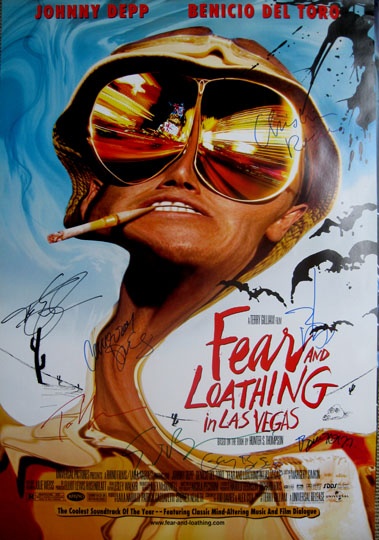
Hunter was an old school Kentucky boy from the 60s, which makes a lot of sense, as he was a riotous outlaw and rabidly individual. He was one of the old guard who remembered what "Freedom" used to mean in the U.S. before Gen Z was raised in the police state. Through his tough guy act, he was also a great listener and a southern gentleman with a passion for justice and the U.S. He said to his friend Ralph, who drew his abstract portraits in Fear and Loathing, that he would oppose his U.S. Citizenship because he didn't deserve it.
When faced with the Hell's Angels or the war in Korea, he wasn't so tough and definitely preferred life.
Personally, Hunter S. Thompson is as American as Mark Twain. They were spokesmen and prophets of their eras, and their dramatic celebrity personas swallowed them. But still very witty. For Hunter, his life depended on his persona, and a good part of his persona was also the astronomical amounts of drugs he was reliant on, even though they hindered and crippled his writing ability. He was someone who never wanted to appear weak. When he was on the drugs, which was always, he was a confident rebel, but they say that he was full of fear and a "vortex of wrath" and indignation, which fueled a lot of his writing. His writing would disregard fact in search of truth. "Everything he wrote was true, but he pretended it wasn't," unlike the others, vice versa.
And his writing power is undeniable, if ludicrous.
"There is no such thing as Paranoia, only Ignorance."
He also randomly capitalizes words... and messes with typeface in his own book. I'm sure he was an influence on House of Leaves.
Personally, my ma told me Johnny Depp's "Captain Jack Sparrow" character was pure Thompson, and I distinctly remember the poster with the crazy neck, so he's always been a myth in the background for me.
P.S. - Oh yeah! He also ran for Sheriff on the Freak Power ticket and almost won... They created a retro-legal gray area in Aspen basically by controlling the Sheriff's office. Local politics for the questionable win?
"The Best Short Stories of Dostoevsky," translated by David Margarshack.
Dostoevsky is great, but full of rambling. Books full of rambling. They were paid by the page at times.
White Nights - Prototype Notes from the Underground, with a happy romantic ending for a guy who gets snubbed at romance.
The Honest Thief - Story about a guy who repents on his deathbed.
The Christmas Tree and a Wedding - Very good, about 1800s society and marriage. A horrible arranged marriage set decades in advance, for a sum of money.
The Peasant Marey - A memory for Dostoevsky, explains his fondness for the common peasants of Russia. SHOULD HAVE BEEN SET IN HOUSE OF THE DEAD, but is not.
A Gentle Creature - It has a very odd taste. The whole book is a revisitation of a failed marriage, that this eccentric man caused by being unnecessarily cold in a marriage of necessity to a wife he truly does admire... What can I say, people are weird, it could very well happen. Personally, it's a captivating tragedy.
Notes from the Underground - What can I say?! Redefined me, slapped me with reality of who I was, and am going to be otherwise... The Crystal Palace is a great symbol of the monument of perfection in the industrial age, a symbol of Modernism, and it shows up in Watchmen, only to be crushed to ordinary "thermodynamic miracles."
The Dream of a Ridiculous Man - Yin to the yang of Notes from the Underground. It beats it with optimism. I'm reminded of a theological lesson, that the reason humanity is doomed is because we are ALL Adam, and we would all eat the apple. We're doomed because we're fundamentally the same and repeat the same mistakes, and the only cure for the Ridiculous Man is to just be ridiculous and love all these crass human fools. Actually, that reminds me of "The Peaceful Warrior, which I also read.
"House of the Dead," by Fyodor Dostoevsky
It's basically a memoir about his time in the Siberian Gulag posed as fiction, and he gets fuzzy on this too. Frankly, it's a miserable hellhole, but the prisoners set up their own little society inside, with their own twisted hopes and dreams, even if it's just to have some vodka and to get whipped for it. It's a lot like the outside world, just purified into "Jailer" and "Jailed." Dostoevsky is a nobility prisoner, but he wants to be with the rough peasants, which in Russia are just called the "Unfortunates," and taken care of by peasants outside the jail. They just happened to have that one rush of passion and finally murdered their wives along with whoever they saw. Yes, and it's a lot like "One Flew the Cuckoo's Nest," -- if these people are crazy, aren't we all? Thinking back, these people basically prefer to stay in jail and don't openly rebel, and when they get released it's Shawshank Redemption, it's hard to adjust to a completely different kind of life. The jailers go along with their charges (who they're afraid of because they outnumber and outmuscle the jailers) on holidays. Gosh, this sounds like society is a prison, and the free life is inconceivable for people in the system.
2026.01.06 - Trejo, by Danny Trejo, Mark Twain's Other Woman, by Laura Skandera Trombley
Someday (!)